“One chocolate at a time.”

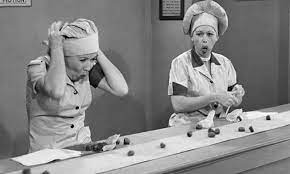
This was the best piece of advice I received from one of my college acting professors, who was otherwise quite a sketchy dude. But, at the start of our senior year in college, he played this famous scene from I Love Lucy and reminded us that when our senior year inevitably became impossibly hectic that we should remember to focus on one chocolate at a time.

I’m having one of those times where I need to remind myself of this. So many balls in the air, so many things to possibly drop. New jobs, new students, new shows, new performances, new creations, new stressors, all wonderful things but they are coming down the line at hyperspeed….

I know some of you also feel this way – say it with me: One chocolate at a time 🤘

Tim McKnight and several of his musician friends presented the very first Tim & Friends concert at Chalice UU back in 2007. It was a concert of superb Classical instrumental music. Then, 13 years later, Tim & Friends returned – almost…  Just three weeks before the scheduled concert on April 5, 2020, the COVID-19 pandemic took hold of the world.   

Undeterred, Tim and his friends are back in 2023 to finish what they started! Veteran “Tim & Friends” performer Susan Spoto is back on the flute.  Joining Tim and Susan are some new friends, including soprano Maria-Pia Duffy-Foltz, clarinetist David Colborn, and yours truly (performing both as a singer and a pianist).  We’ve broadened our musical horizons for this performance, which means that in addition to great Classical music of Schubert, Mozart, Fauré, Stravinsky and Strauss, you’ll also hear musical theatre and jazz selections from Sondheim, Schwartz, Kern, Bolling, Ellington, and Tesori.   

Come join us on Saturday, September 30, 2023 at 2:00pm in the Chalice chapel.  A donation of $20 per person is requested for this performance.  Sweet and savory snacks and an array of beverages will be served for this afternoon concert. To reserve your seats in advance, please e-mail music@chaliceuucongregation.org.

Calling all San Diego variety performers – more information about auditions coming soon!

We’ll be looking for all kinds of acts – singing, dancing, movement, burlesque, acrobatics, clowning, comedy, drag arts, magicians, unique specialty acts – all will be welcome at auditions. We’re also looking for visual and/or multimedia artists whose work will be displayed during performances.

Stay tuned!

At yesterday morning’s service at St. Peter’s, the rector turned to the choir as she always does every Sunday and offered her thanks for the musicians at the service. Note, friends, that she referred to us as “musicians,” and I appreciate it every time.

That’s because, unfortunately, the music world tends to perceive singers as “less-than.” To some, we are simply either lucky or, at best, trained monkeys. It is often assumed we do not know anything about music and that we can only copy what we have heard on a recording. I have literally been asked in an audition what key a song was in, and after I answered correctly I was immediately interrogated on how I could possibly know such a thing. Another time, I was a paid section leader in a choir, and when I offered to help a bell ringer with his part he told me “thanks, but it’s in bass clef,” as if that would be a hindrance. Another church I worked at neglected to provide me with a name tag after a year of me asking, yet the new pianist had a name tag his very first day. How many times have I heard “there’s a budget for the string quartet/pianist/bagpipe player but not for the singers.” (Countless.) And of course, there are the multitudes of masterworks performed where the conductor thanks the “musicians and singers,” which doesn’t ever help.

I have news for y’all. A singer is every bit as much of a musician and artist as any instrument player. Our music comes from within our body – we create something from nothing, with no help except for, well, I don’t know, THOUSANDS OF HOURS OF TRAINING AND PRACTICE. People applaud the concertmaster and muse they must have spent their youth practicing and a fortune on lessons, but what of the singer? I have spent so much time in practice rooms, classrooms, choir rooms, lessons, plus a four-year degree; and we’re not even going to discuss the cost.

Of course, I do not mean to detract from the skill and knowledge of the instrumentalist; I only argue that singers are entitled to the same respect and this is a stigma I work very hard to correct in my daily life.

But, what really breaks my heart is when my students are defeated before they begin – I hear “I don’t know anything about music” from the most unbelievable sources. Singers who can bring a house down and mesmerize every audience member from here to Tokyo, stand there and say they don’t know anything about music and don’t feel capable of learning. ABSOLUTELY NOT.

First of all – you are already a musician. Full stop. You create art with your body in a way that is entirely unique to you. That makes you a musician.

Second, if you want to learn music theory, terms, definitions – you are FULLY CAPABLE of learning! You are not at a disadvantage just because you’re a singer – again, absolutely not. Find the right teacher, the right environment, and you can learn anything you want.

Ok, I’ll get off my soapbox now. But remember, friends – if you make music, you’re a musician, and don’t let any fool tell you otherwise.

Break a leg out there!
Identifying your unique strengths is key to success. Knowing where you shine will inform almost every artistic decision you make: (1) what roles to pursue, (2) what audition materials to use, and (3) how you present yourself to the world/industry/public. In an earlier blog entry about audition song selection, I touched on the idea of showcasing your unique strengths. But, what do I really mean by that? Here’s how I work through this with my students.

To state the obvious, your unique strengths are those assets and abilities you have that make you stand out from the average.

Now, how on earth are you supposed to know what your unique strengths are? What an awkward question.

That’s where a coach comes in. Having an outside professional, whether me or someone else, work with you on identifying your strengths can help bring needed perspective and clarity to this question. You may not have heard a bunch of people in your city sing or perform, so how are you supposed to know where you fit? Your coach has, and can bring that knowledge to the table. For example, I once told a student who was auditioning for a rock musical, “the panel is going to hear over a hundred pretty girls who can sing. But they aren’t going to have that many who can sing a rock song like you, so let’s feature that in your audition.”

What qualifies as a unique strength? By “unique” I don’t mean “only one in the world;” I mean more than or higher than average. When I ask my students what their unique strength is, I’m often provided with this answer: “singing!” To which I teasingly respond, “singing what?” and that’s when I get the blank stare.

To successfully identify your unique strengths, you will need to get specific. There’s a ton of amazing singers out there! What are YOU specifically good at? Can you belt up high like a gospel singer? Are you so powerful you don’t need a microphone? Do you have a rich, velvety lower range? Can you spit out “Speed Test” faster than anyone? Can you move anyone to tears with your heart-wrenching ballad?

Of course, you may not have a unique strength related to singing. What other possible unique strengths are there? How about look – do you look particularly young or old for your age? Are you particularly tall or short? Can you tap dance? Play a musical instrument? How about dialects? The possibilities are endless!

So, what are YOUR unique strengths? Once you know what they are, you can begin to feature them more and really start elevating your auditions and performances.

Break a leg out there!